

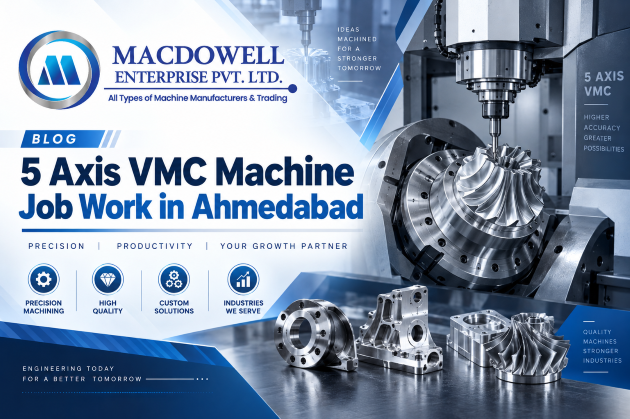
5 Axis VMC Machine Job Work in Ahmedabad
5 Axis VMC Machine Job Work in Ahmedabad
Modern industries require components that are accurate, complex, durable, and manufactured with consistent quality. Traditional machining methods are suitable for many regular jobs, but when a component contains multiple angles, intricate profiles, deep cavities, curved surfaces, or tight tolerances, advanced machining technology becomes essential.
5 Axis VMC Machine Job Work in Ahmedabad provides a practical solution for manufacturers that need high-precision machining without investing in expensive machining infrastructure. With advanced 5-axis machining technology, multiple surfaces of a component can be machined efficiently while reducing repeated setups and improving overall accuracy.
Ahmedabad is one of Gujarat’s major industrial hubs, serving industries such as engineering, automotive, pumps, valves, machinery, tooling, aerospace-related manufacturing, automation, and industrial equipment. Reliable CNC and VMC job work therefore plays an important role in supporting local manufacturers.
What is a 5 Axis VMC Machine?
A 5 Axis VMC, or Vertical Machining Center, is an advanced CNC machine capable of moving a cutting tool or workpiece across five different axes.
A conventional 3-axis machine generally operates along the X, Y, and Z directions. A 5-axis machining center adds two rotational movements, allowing the cutting tool to approach the component from different angles.
This capability makes it possible to manufacture complicated components with fewer setups.
Instead of removing the component and manually repositioning it repeatedly, a 5-axis machine can reach several areas of the job during a single machining cycle. This helps improve dimensional accuracy, surface consistency, and production efficiency.
Why Choose 5 Axis VMC Machine Job Work?
Industries often select 5-axis machining when conventional machining processes cannot achieve the required geometry or accuracy efficiently.
One of its biggest advantages is the ability to machine complicated shapes in fewer operations. Components containing angular holes, pockets, contours, slopes, curves, and multiple machining faces can be produced with greater consistency.
Reduced component handling also minimizes alignment errors.
Every time a component is removed and repositioned, there is a possibility of variation. By machining multiple sides in a single setup, 5-axis machining can help maintain better positional accuracy.
Another important advantage is productivity. Reduced setup time and optimized machining can help shorten manufacturing cycles, particularly for complex components.
Applications of 5 Axis VMC Machining
5 Axis VMC job work can be used across a wide range of industrial applications.
Common machining requirements include:
- Precision machine components
- Automotive parts
- Pump and valve components
- Dies and mould components
- Industrial equipment parts
- Hydraulic and pneumatic components
- Tool room components
- Jigs and fixtures
- Engineering prototypes
- Complex metal components
- Customized machinery parts
- Automation equipment components
The actual machining process depends on the component drawing, material, tolerance, surface finish, quantity, and application.
Machining Complex Industrial Components
Complex industrial components are often difficult to manufacture using conventional machining because several operations may be required.
For example, a component may contain holes on different angles, deep pockets, curved profiles, precision bores, and machined surfaces on multiple sides.
With 5 Axis VMC machining, these operations can be planned more efficiently.
Advanced tool paths allow the cutting tool to approach the component at suitable angles. This can improve accessibility and reduce unnecessary repositioning.
For manufacturers in Ahmedabad who regularly develop customized components, special-purpose machine parts, dies, fixtures, or prototypes, this flexibility can be especially useful.
Better Accuracy and Repeatability
Accuracy is one of the most important factors in industrial machining.
Even a small dimensional variation can create assembly issues, vibration, leakage, improper fitting, or reduced performance in the final machine.
5-axis machining reduces the number of setups required for many complicated jobs. Fewer setups can reduce cumulative positioning errors and improve consistency between machining operations.
Repeatability is equally important for batch production.
Once the machining program, tool selection, work holding, and process parameters are properly established, CNC machining can produce multiple components with consistent dimensions.
Improved Surface Finish
Surface finish is important for both appearance and functional performance.
Certain components require smooth machining because they interact with bearings, seals, mating surfaces, sliding mechanisms, or precision assemblies.
In 5-axis machining, the orientation of the cutting tool can be adjusted according to the component geometry. This allows more suitable cutting positions to be maintained during machining.
As a result, complicated curved or contoured surfaces can often be machined more smoothly compared with processes that require frequent repositioning.
Final surface quality will still depend on factors such as material, cutting tools, machine condition, machining strategy, speed, feed, and finishing requirements.
Materials Suitable for VMC Machine Job Work
5 Axis VMC machines can process various engineering materials depending on machine capability and tooling.
Typical materials may include:
Aluminium: Frequently used for lightweight machine parts, fixtures, automation components, prototypes, and engineering products.
Mild Steel: Commonly used for general engineering and machinery components.
Stainless Steel: Used where corrosion resistance, durability, and strength are important.
Tool Steel: Often used for dies, moulds, tooling, and special industrial components.
Brass and Copper: Suitable for selected electrical, industrial, and precision engineering applications.
Material selection should always be based on the mechanical requirements and final application of the component.
Prototype and Batch Production
5 Axis VMC Machine Job Work in Ahmedabad is suitable not only for production components but also for prototype development.
During the development stage of a new machine or industrial product, manufacturers may require only one or a few components for testing.
CNC machining makes it possible to manufacture these prototypes directly from CAD drawings or engineering models.
After testing and approval, the same machining concept can be optimized for repeat production.
This helps engineering companies move from product development to manufacturing without completely changing the production method.
Importance of Proper CAD/CAM Programming
A modern CNC machine alone does not guarantee accurate components.
Professional CAD/CAM programming plays an equally important role.
The programmer must determine suitable machining strategies, cutting tools, tool paths, cutting parameters, work holding positions, and machining sequences.
For 5-axis components, tool movement must be carefully controlled to avoid collisions while maintaining efficient cutting.
Good programming can help:
- Reduce unnecessary tool movement
- Improve machining time
- Maintain component accuracy
- Achieve better surface finishing
- Increase tool life
- Reduce machining risks
This is why experience in both machining and programming is important when selecting a VMC job work partner.
Quality Inspection for Precision Components
Precision machining should always be supported by proper inspection.
Depending on the job requirement, inspection may include dimensional checking, bore measurement, height measurement, angle verification, surface inspection, and tolerance checking.
Manufacturing according to the provided engineering drawing is important because each industrial component may have different tolerance requirements.
Critical dimensions should be checked carefully before delivery, especially when parts are used in assemblies or precision machinery.
Benefits of Choosing Local VMC Job Work in Ahmedabad
Working with a local machining partner in Ahmedabad can offer practical benefits for engineering companies.
Communication becomes easier when drawings, samples, modifications, and technical discussions are involved. Local customers can also coordinate more efficiently during prototype development or urgent production requirements.
For repeat jobs, an established machining process can help reduce development time for future orders.
Ahmedabad’s strong manufacturing ecosystem also makes it convenient for businesses requiring machining as part of a larger production process involving fabrication, grinding, coating, assembly, or other engineering operations.
Choosing the Right 5 Axis VMC Job Work Partner
Before finalizing a machining supplier, manufacturers should evaluate several factors.
Look for a company that understands engineering drawings, component tolerances, machining processes, tooling, and quality inspection.
It is also useful to discuss:
- Component material
- Quantity required
- Drawing or 3D model
- Dimensional tolerance
- Surface finish
- Delivery requirement
- Inspection standards
- Prototype or production quantity
Providing complete information helps the machining team plan the job accurately and provide a suitable production approach.
Conclusion
5 Axis VMC Machine Job Work in Ahmedabad is an effective solution for industries requiring accurate and complex machined components.
With the capability to machine multiple surfaces, angled features, complicated profiles, and precision geometries in fewer setups, 5-axis machining can improve manufacturing efficiency while maintaining consistent quality.
Whether the requirement is for a prototype, customized machine component, tooling part, or repeat production batch, selecting an experienced machining partner is essential.
For manufacturers looking for precision machining solutions in Ahmedabad, professional 5 Axis VMC job work can help transform engineering drawings into reliable industrial components with the accuracy and finish required for modern manufacturing.